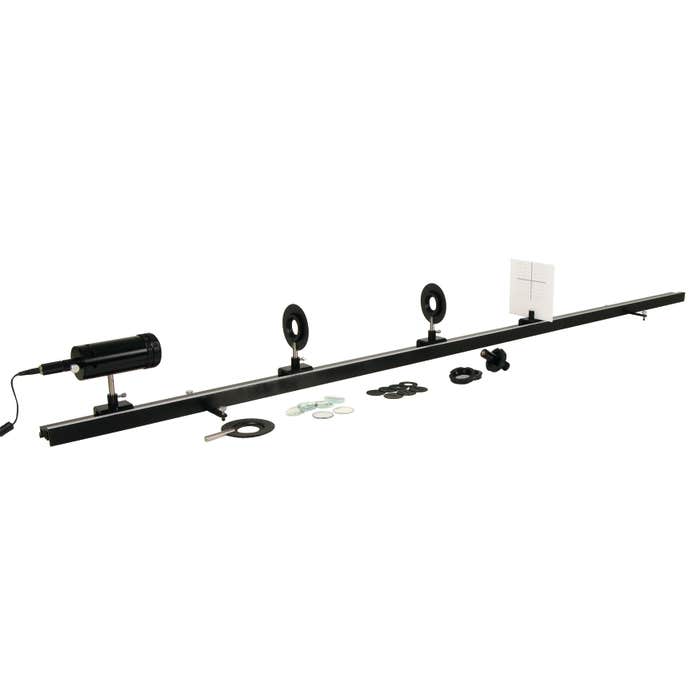




Basix Dual Clix Start Profile Composition

Ovio instruments
The strong points
  • Ready to use for focometry and diffraction

  • Enjoy the practical and clever Clix system

  • Aluminum profiled bench available in 2 lengths: 2 m and 1.2 m

From
€466.67 €560.00
Instead of €626.40 Incl. €0.00 eco-part (Incl. Tax)
Configuration

Model
SKU Longueur Graduation Price Available Amount Basket
204173 1.20 m -20 à 180 cm, every mm
€466.67 €560.00 Instead of €626.40

-11%

Replenishment in progress
+
202953 2 m -20 à 180 cm, every mm
€506.67 €608.00 Instead of €676.40

-10%

Replenishment in progress
+

A complete and practical optical bench for your high school experiments

The Basix Dual Clix Start profile set is specially designed to support the teaching of optics in middle and high schools. It allows for direct execution of focometry and diffraction experiments, providing teachers with a comprehensive and ready-to-use tool to illustrate the essential concepts of the curriculum. Its robust and precise design ensures reliable alignment of optical devices and reproducible results during manipulations.

Equipped with Clix magnetic supports, this set offers true ease of use. The magnetic hold facilitates quick placement of elements and their stability throughout the experiments. This system reduces the risk of misalignment and allows students to focus on observing light phenomena, thereby enhancing understanding and teaching effectiveness.

Thanks to its Basix profile, this bench combines versatility and durability. It easily fits into school laboratories and can be supplemented with other optical accessories to enrich practical work. Designed for regular use, it is a reliable and scalable solution to approach the main optics experiments in class.

What educational experiments can be practically conducted?

Image formation by a thin lens

Practical activities to understand image formation and fundamental optical relationships.

  • Conjugation laws: study of the relationship between the position of the object, the image, and the focal length (application of conjugation equations).
  • Experimental demonstration: observation of the position and size of the image depending on the object–lens distance (concepts of real/virtual image, upright/inverted image, and magnification).

Determination of the focal length of a converging lens

Several experimental methods adapted to school teaching and practical sessions.

  • Autocollimation method: a converging lens is placed against a plane mirror to obtain a sharp image of the same size as the object but inverted. With this method, the focal length of the lens corresponds to the distance between the lens center and its image.
  • Bessel method: use of two symmetrical lens positions giving a sharp image; the difference between positions allows calculation of the focal length.
  • Silbermann method: this is a special case of the Bessel method, also called the 2f-2f method.

Study of diffraction through a slit

Observation of a laser beam passing through a narrow slit to demonstrate the diffraction phenomenon.

  • Width of the central maximum: visualization of the diffraction pattern on a screen and measurement of the central maximum width as a function of the slit width.
  • Influence of slit width: comparison of patterns obtained with different slits.
  • Influence of wavelength: comparison of patterns obtained with different monochromatic sources to show the relationship between λ and the pattern width.

Study of interference through a double slit

Experiments demonstrating the superposition of two coherent light waves from the same source, illustrating the wave nature of light.

  • Interference fringes: observation of fringes on a screen, measurement of fringe spacing.
  • Determination of wavelength: use of fringe measurements to calculate the wavelength of a laser source.
  • Young’s slits vs. asymmetric double slits: comparison of patterns obtained with two identical slits (regular and symmetrical interference) and with slits of different widths (intensity modulation and fringe asymmetry).


Is this product suitable for the high school physics curriculum?

Yes. The proposed manipulations and protocols (image formation by thin lens, determination of focal length by autocollimation, Bessel method, and Silbermann method) directly align with the educational objectives of science teaching in high school—from 10th grade to 12th grade specialty. They allow for a progressive and curriculum-compliant approach to the concepts of conjugation, focal length, and experimental measurements.

Correspondence between experiments, levels, and curriculum points

ExperimentsRelevant levelsTargeted curriculum points
Image formation by a thin lens10th grade, 11th grade specialty- Qualitative study of image formation by converging lenses
- Conjugation laws (relating object position, image position, and focal length)
- Observation of image size and sharpness depending on object-lens distance
Determination of the focal length of a converging lens11th grade specialty, 12th grade specialty- Experimental measurements of the focal length of a converging lens
- Experimental use and modeling of optical systems
- Autocollimation, Bessel, and Silbermann methods deepen the study of focal length, consistent with experimental practices
Study of diffraction through a slit11th grade specialty, 12th grade specialty- Demonstration of the wave nature of light.
- Observation and measurement of the diffraction pattern (width of the central maximum as a function of slit width).
- Dependence of diffraction on wavelength.
Study of interference through a double slit11th grade specialty, 12th grade specialty- Young’s slit experiment: observation and measurement of interference fringes.
- Determination of the wavelength of a laser source by analyzing fringe spacing.
- Comparison between two identical slits and asymmetric slits (impact on intensity and fringe symmetry).


What items are included with this setup?

- 1 Basix aluminum profiled bench with adjustable feet, 1.2 m (ref. 202959) or 2 m (ref. 202958)
- 1 carrier for source (ref. 204060)
- 4 standard carriers for Basix profile (ref. 202861)
- 1 LED lantern with frosted "d" object, condenser, and power supply (ref. 204596)
- 1 additional object holder ring (ref. 201044)
- 1 red token laser (ref. 202863)
- 1 grid screen (ref. 202955)
- 3 low-profile Clix supports (ref. 204245)
- 5 magnetic Clix rings (ref. 204201)
- 1 set of 4 lenses - 2 mirrors (ref. 682558)
- 1 set of 6 metal diaphragms (ref. 202252)
- 1 metal "F" object token (ref. 212080)
- 1 token with 12 single slits (ref. 204012)
- 1 token with 12 double slits (ref. 204013)
Delivered with a cardboard storage case.

What extensions or accessories can be added to this product to enhance optical bench experiments?

- CCD sensor (ref. 209007)
- Clix 360 polarization set (ref. 204338)
- LCD complement (ref. 204339)


Type of benches Basix
Component type 5 carriers, 1 bench, 6 metal diaphragms, 1 screen, 2 diffraction tokens, 1 lantern, 1 laser, 4 lenses and 2 mirrors, 1 focometry object, 3 component holders