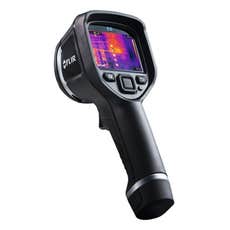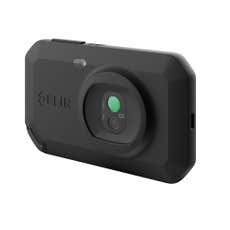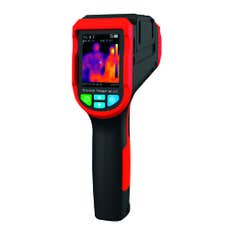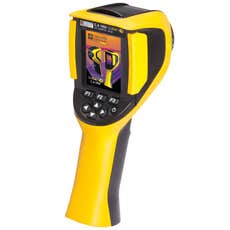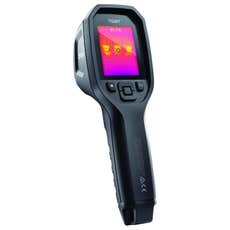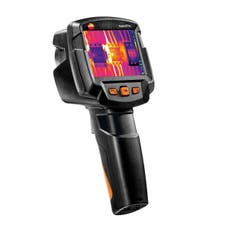




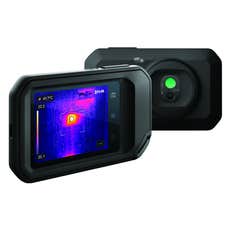
A thermal camera functions like an eye, but instead of capturing visible light, it detects infrared waves with wavelengths longer than those of the visible spectrum. Everything in our environment emits radiation not only in the visible spectrum but also in the infrared. Only certain snakes can naturally perceive infrared; humans cannot, although we can still feel heat when it is nearby. A thermal camera therefore makes it possible to detect temperature at a distance, even in complete darkness or through smoke and fog, and to quickly identify temperature variations and anomalies that are invisible to the naked eye.
Within a specific part of the infrared spectrum (the 8–14 µm band), scientists discovered that emitted energy increases with the temperature and material of the observed object. To measure this, they use a sensor called a bolometer. A thermal camera can thus be compared to an eye whose retina is made of a matrix of bolometers, with fine adjustment capabilities depending on the material observed (emissivity setting). Recent technological advances offer compact, connected (Wi-Fi, smartphone), and increasingly sensitive models, making thermography accessible to all professionals.
How does a thermal camera work in two steps?
> Infrared detection: Every object emits thermal radiation proportional to its temperature. The camera captures these infrared waves, which are invisible to the human eye.
> Conversion into an image: The infrared sensor converts this radiation into an electrical signal, which is then processed to generate a thermal image displayed on the screen. Hot areas generally appear in red, white, or yellow, while cold areas appear in blue or black.